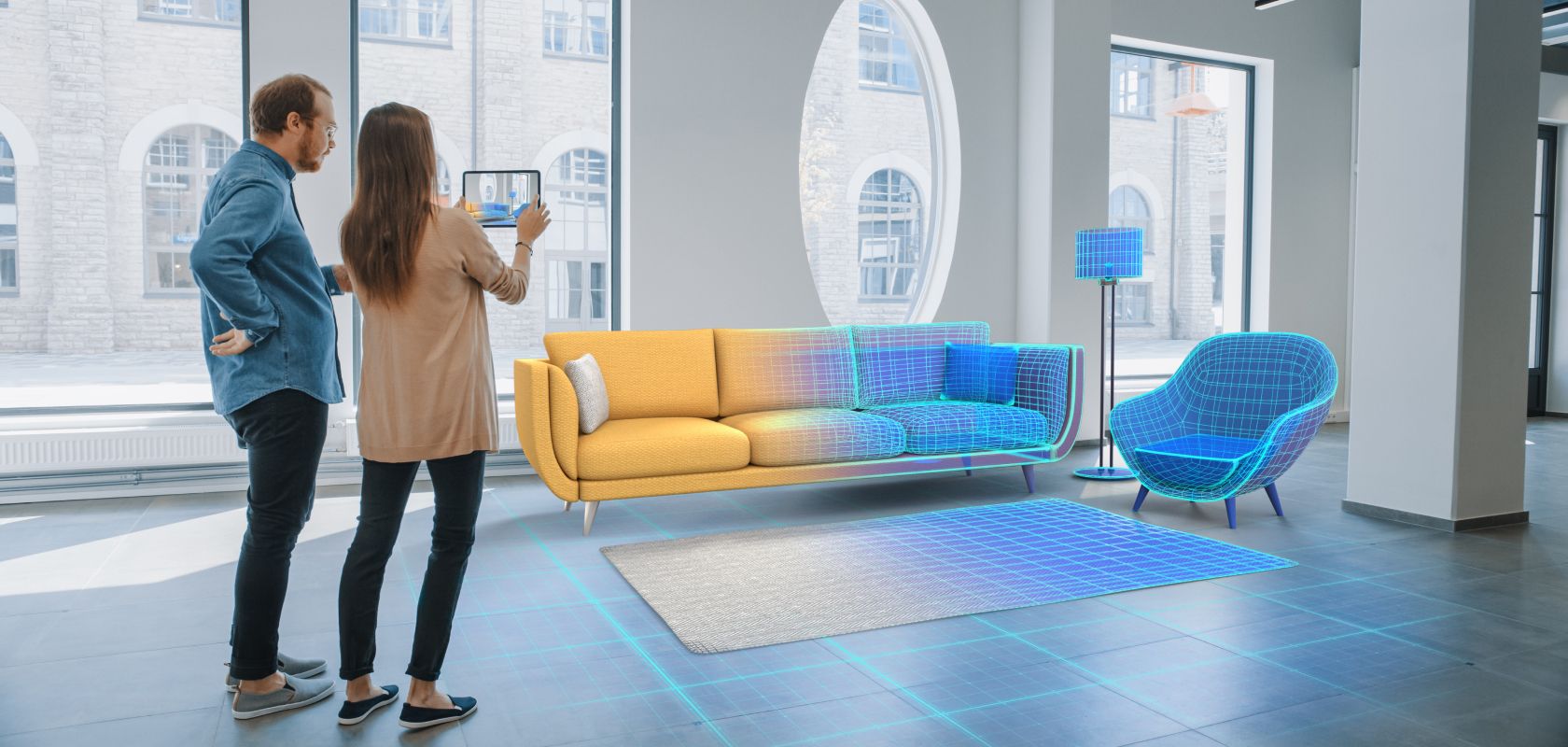
Augmented reality has fundamentally transformed the furniture and home décor retail landscape, addressing one of e-commerce’s most persistent challenges: helping customers confidently purchase bulky, expensive items they cannot physically inspect before delivery. By enabling shoppers to visualize furniture and décor in their actual living spaces with photorealistic accuracy before committing to purchase, AR technology has evolved from a novelty feature into an essential competitive differentiator that drives measurable business results and dramatically improves customer satisfaction.
The Scale of AR Home Shopping
The AR furniture shopping market is experiencing explosive growth that mirrors broader trends in immersive retail technology. The global AR furniture market is projected to reach $15.6 billion by 2025, growing at a compound annual growth rate (CAGR) of 32.8%. This rapid expansion reflects both consumer demand and retailer recognition that AR visualization is no longer optional but fundamental to modern furniture retail. The broader AR/VR market has reached $200.87 billion in 2025, with home décor driving significant adoption.
Contextualizing this within the overall furniture market provides perspective: the global furniture industry is valued at $691.87 billion in 2025 and is projected to reach $902.09 billion by 2030, growing at a CAGR of 5.45%. Within this enormous market, AR represents the fastest-growing segment, with online furniture sales rising at an accelerated 9.7% CAGR, making the digital channel the fastest-expanding distribution method.
How AR Furniture Visualization Works
Room Scanning and Digital Environment Creation: The technology begins by using smartphone cameras to scan and analyze the physical space. Advanced computer vision algorithms create a detailed digital map of the room, identifying floor planes, walls, ceiling height, and existing lighting conditions. This environmental analysis establishes the foundation for accurate virtual furniture placement.
True-to-Scale 3D Modeling: Furniture retailers invest in creating precise 3D models of products, capturing accurate dimensions, materials, finishes, and colors. IKEA’s IKEA Place app pioneered this approach, utilizing Apple’s ARKit and Google’s ARCore frameworks to deliver true-to-scale products with accurate lighting and shadows. These models incorporate photogrammetry—the process of creating 3D digital representations by analyzing thousands of photographs from multiple angles—ensuring virtual products appear indistinguishable from actual items.
Real-Time Placement and Physics Simulation: Users can drag and drop virtual furniture into their visualized space with intuitive touch controls, positioning items at any location and angle. Physics-based rendering ensures furniture appears to interact realistically with the environment—shadows fall naturally, lighting reflects accurately, and items position themselves on surfaces with proper depth and perspective.
Dynamic Lighting and Material Rendering: Modern AR systems simulate how different materials respond to room lighting conditions. A wooden table appears with appropriate wood grain texture and finish, while a glossy sideboard reflects light realistically. This dynamic rendering adjusts in real-time as users move their devices, creating photorealistic previews that closely match how products appear in physical environments.
Interactive Customization: Users can modify virtual furniture in real-time—changing colors, materials, sizes, and styles—to see exactly how each variation appears within their specific space. This interactive capability enables rapid exploration of design alternatives without purchasing multiple items to test combinations.
IKEA’s Place App: The Market Leader
IKEA’s IKEA Place app represents the most successful and widely-adopted AR furniture visualization platform, demonstrating the transformative potential of this technology at scale. The app has been downloaded over 8 million times and shows engagement rates 3x higher than traditional product browsing, establishing it as the market standard for AR furniture retail.
Key Performance Metrics: IKEA Place contributed to a remarkable 189% conversion rate increase for AR-enabled products compared to traditional shopping. The app reduced return rates for large items by up to 22%, directly protecting profit margins while improving customer satisfaction. These results demonstrate that AR doesn’t merely enhance experience—it fundamentally improves business outcomes.
Implementation Excellence: IKEA’s success stems from combining technical sophistication with user-centered design. The app employs advanced AR capabilities including drag-and-drop furniture placement, true-to-scale visualization, integration with IKEA’s complete catalog across multiple countries, and localization features reflecting regional product availability and lighting preferences. Most critically, IKEA ensured AR experiences were highly accurate in terms of scale and appearance, creating the trust necessary for confident purchasing.
AI-Enhanced Evolution: Modern iterations of IKEA Place incorporate advanced AI capabilities that transcend simple furniture placement. The app now suggests furniture arrangements based on user preferences, room dimensions, and existing décor styles, creating personalized shopping experiences that guide customers toward configurations most likely to satisfy their aesthetic and functional requirements. This personalization represents the convergence of AR visualization with intelligent recommendation systems.
Wayfair’s “View in Room” Platform
Wayfair, a dominant force in online home goods retail, implemented its “View in Room” AR feature enabling customers to visualize furniture and décor in their homes with sophisticated accuracy. The results have been exceptional: Wayfair reports 92% higher conversion rates for AR-enabled products, with customers using AR features being 11x more likely to make a purchase compared to those using traditional browsing.
Comprehensive Functionality: Wayfair’s AR solution includes placement of true-to-scale 3D product models in customer spaces, ability to view products from any angle, realistic rendering of textures and materials, product recommendations based on viewed items, and seamless integration with Wayfair’s mobile app. The platform enables customers to visualize how a chandelier hangs above a dining table or whether a throw pillow matches their décor—addressing the specific uncertainties that drive furniture return rates.
Mobile and Social Integration: Wayfair enhanced its AR ecosystem to include social features where users can share designs and participate in community voting, earning points for beautiful designs redeemable for discounts. This social gamification increases engagement and creates viral opportunities as customers share AR visualizations across social networks.
Quantifiable Impact on Customer Behavior and Business Metrics
Engagement and Time Investment: The immersive nature of AR furniture shopping fundamentally changes how customers interact with products. Furniture retailers implementing AR features report average session durations 2.7x longer than traditional product pages, with users spending 4.2 minutes interacting with AR-enabled furniture compared to 1.6 minutes on standard product pages. Customers using AR features view products from multiple angles 85% more often, explore different color and material options 3.2x more frequently, and share AR visualizations with family members 67% of the time.
Conversion Rate Improvements: AR implementation consistently drives conversion improvements across furniture categories. Industry data shows:
- West Elm: 40% increase in conversion rates for AR-enabled products
- Pottery Barn: 35% higher purchase likelihood with AR visualization
- Ashley Furniture: 28% improvement in online-to-store conversion
- Wayfair: 11x higher purchase probability with AR interaction
These improvements reflect the core mechanism: when customers can accurately visualize products in their spaces, uncertainty diminishes and purchase confidence increases.
Return Rate Reduction: Perhaps the most economically significant AR benefit is return rate reduction. Research by Magna Media Trials shows that AR introduction has reduced return likelihood by 64%, while Shopify observed a 40% decrease in returns through AR implementation. Specific reduction data demonstrates the magnitude of this impact:
- Size-related returns: 71% reduction in “too large/small” returns with 89% accuracy in AR size visualization
- Style and color returns: 58% reduction in color/style mismatch returns with 92% customer satisfaction regarding AR color accuracy
- Fit returns: 73% reduction in size-related returns for sofas specifically
For a mid-size furniture retailer, these return reductions translate to $2.3 million in annual savings. Given that furniture represents one of the highest-value retail categories, these logistic and inventory management savings represent substantial contributions to profitability.
Average Order Value Enhancement: AR doesn’t merely increase conversion frequency—it expands order size. Customers using AR features tend to:
- Purchase 23% more items per transaction
- Choose higher-priced product variants 31% more often
- Add complementary items to their cart 45% more frequently
- Spend an average of $127 more per order
This average order value increase reflects customer confidence gained through visualization: when shoppers can see how items coordinate, they’re more likely to purchase complementary pieces they might have otherwise skipped.
Advanced Applications Beyond Individual Product Placement
Virtual Room Planning: The next evolution beyond single-product visualization is comprehensive room planning, where customers design entire spaces rather than placing individual items. Virtual room planners show even more impressive engagement metrics:
- Average session duration: 12.4 minutes (compared to 4.2 minutes for single-product AR)
- Return visit rate: 78% within 7 days
- Social sharing rate: 45% of completed designs
- Conversion to purchase: 34% higher than standard browsing
These metrics indicate that room planning creates a substantially more immersive and engaging experience, transforming furniture shopping from transactional purchasing into creative, collaborative design activity.
Smart Mirrors and In-Store AR: While mobile AR dominates, in-store smart mirrors represent an emerging channel. These devices, typically deployed in physical retail locations, enable customers to virtually try on furniture styles or visualize how items would appear in their homes without leaving the showroom. Smart mirrors can integrate with smart home ecosystems, connecting with smart lighting, thermostats, and voice assistants to create seamless experiences where AR visualization extends into smart home control.
AI-Powered Space Optimization: Advanced implementations employ AI algorithms to analyze room dimensions and suggest optimal furniture arrangements. Systems can identify opportunities for space-saving modular furniture, recommend traffic flow optimization, and suggest item combinations that maximize functionality while maintaining aesthetic coherence. This intelligent guidance transforms AR from visualization tool to comprehensive interior design assistant.
Industry Implementation and Consumer Adoption
Widespread Retailer Adoption: The furniture retail landscape has largely embraced AR as essential infrastructure. According to research by London Research and visual commerce firm Fixtuur, 96% of senior UK and US furniture industry leaders confirm that AR and 3D tools have increased sales, and 82% identify strong return on investment. However, implementation lags behind growth: only 58% have adopted AR technology, creating significant competitive opportunities for early movers.
More importantly, firms outperforming peers—designated “eCommerce Leaders”—are leading adoption: 64% of these leaders offer fully integrated AR experiences compared to 45% of mainstream retailers, and 90% plan to expand visual technology use in 2025. This divergence indicates that AR implementation is becoming a competitive requirement for market leadership.
Consumer Expectations and Willingness to Pay: Consumer sentiment reflects the value created by AR visualization. 90% of Americans currently use or would consider using AR for shopping, demonstrating mainstream acceptance. Beyond adoption, consumer preferences are shifting: 71% of consumers are more likely to frequent stores implementing AR, and 40% of consumers are willing to pay more for products that can be customized via AR.
This willingness to pay premium prices represents a fundamental shift: consumers view AR-enabled shopping not as feature parity but as legitimate value enhancement worth rewarding with increased spending. Research indicates 70% of retailers report that customers expect to customize furniture online, 60% to visualize items in their own space, and 61% to experience immersive journeys rivaling physical showrooms.
Market Trends and Regional Growth
E-commerce Acceleration: Digital transformation is accelerating furniture retail growth, with online sales becoming the fastest-expanding distribution channel at 9.7% CAGR. This growth exceeds overall furniture market growth of 5.45%, indicating that e-commerce’s rising share significantly outpaces brick-and-mortar expansion.
Geographic Expansion: High-growth markets for furniture include India (CAGR 8.80%), GCC countries (7.30%), and the USA (3.16%) through 2030. In emerging markets like India, e-commerce has particularly accelerated, with online furniture sales growing 22% in 2023 alone, boosting unorganized carpentry networks by making their products accessible to geographically distributed customers. Latin America’s furniture market, particularly Brazil as the leading country, is valued at $34.6 billion in 2024 and projected to reach $44 billion by 2030.
Customization and Modular Furniture: Urbanization drives demand for space-saving modular furniture (projected CAGR 1.5% impact on growth through 2030), while home remodel spending by millennials creates demand for multi-functional furniture (1.2% projected CAGR impact). AR visualization particularly benefits these categories by enabling customers to envision customized configurations and modular arrangements in their specific spaces.
Technological Innovations and Future Directions
Advanced 3D Body and Space Scanning: While traditionally focused on furniture placement, emerging systems integrate advanced 3D room scanning that captures precise room dimensions, floor materials, wall colors, and lighting characteristics. Combined with body scanning for ergonomic furniture recommendations, these systems create highly personalized recommendations.
5G-Enabled Virtual Showrooms: 5G technology accelerates AR’s evolution by enabling higher data transfer speeds and lower latency, facilitating more seamless, immersive experiences. Virtual reality showrooms powered by 5G connectivity enable customers to explore interactive home tours and visualize how various layouts and items fit within spaces with unprecedented responsiveness.
Haptic Feedback Integration: Emerging systems are beginning to integrate touch simulations, allowing users to “feel” fabric texture, weight, and structure through haptic feedback devices. While currently nascent, this multisensory dimension will provide experiences matching physical try-on more closely.
WebAR Accessibility: WebAR—browser-based AR experiences eliminating app installation requirements—has significantly reduced adoption friction. Users can access AR experiences directly from brand websites or social media without complicated setup procedures, democratizing AR access and increasing mainstream adoption.
Challenges and Barriers to Widespread Adoption
Platform Fragmentation: Developers must optimize across ARKit (iOS), ARCore (Android), and browser-based implementations, each with different technical requirements, increasing development complexity and cost. 3D Content Creation Complexity: Developing realistic 3D product models and maintaining catalogs across thousands of SKUs requires specialized expertise and substantial investment. Device Dependency: Experience quality varies based on smartphone capabilities, limiting access for consumers with older devices. Privacy Considerations: Facial recognition and space scanning raise privacy concerns requiring robust data protection mechanisms and transparent policies to build consumer trust. Accessibility Gaps: Motion simulation capabilities and advanced scanning applications remain relatively inaccessible for certain user segments.
Economic Impact and Sustainability Benefits
Beyond immediate sales and return reduction, AR furniture shopping generates broader economic benefits. Goldman Sachs estimates that AR 3D visualization services will save the furniture industry over $1.6 billion in returns and lost sales by 2025, demonstrating the technology’s macroeconomic significance. By reducing returns, overproduction, and waste, AR aligns business imperatives with sustainability goals—lowering environmental impact while simultaneously improving profitability.
Augmented reality has transformed furniture and home décor shopping from an anxiety-inducing online gamble into a confident, interactive design experience rivaling—and in many ways exceeding—physical retail. By enabling customers to visualize products in their actual living spaces with photorealistic accuracy, AR drives measurable improvements in conversion rates (up to 200%), average order values (+$127), return reduction (64% average decrease), and customer satisfaction. IKEA’s and Wayfair’s successful implementations validate the business case at scale, while emerging AI-powered personalization and comprehensive room planning capabilities point toward even greater transformation. As consumer expectations accelerate and adoption barriers diminish through WebAR accessibility and improved device capabilities, AR furniture shopping is transitioning from market differentiator to essential retail infrastructure. For furniture brands not yet implementing comprehensive AR visualization, the competitive window for differentiation is rapidly closing as this technology becomes an expected standard rather than an optional feature.